belousov.tel

DPG Spring meeting of the Condensed Matter Section 2026

Microcanonical ensemble

out of equilibrium

Roman Belousov with J. Elliott, F. Berger, L. Rondoni, and A. Erzberger
Erzberger Lab | EMBL EMBL, Heidelberg

Phys. Rev. E 113, 014133 (2026)

Boltzmann Boltzmann's monode

Microcanonical ensemble: all states are equally likely, energy EE and number of particles NN are fixed.
Boltzmann entropy
SB(state)=kBlnW(realization  macrostate) S_{\rm B}(\text{state}) = k_{\rm B} \ln W(\text{realization}\ |\ \text{macrostate})
Euler equation for equilibrium thermodynamics
E=TSPV+μNE = T S - P V + \mu N
Statistics of fluctuations
p(state)eSB(state)/kBp(\text{state}) \propto e^{S_{\rm B}(\text{state})/k_{\rm B}}

Gibbs Gibbs' ensemble theory

Probability and information theory
(Shannon-)Gibbs entropy
SG=kBstatesp(state) lnp(state) S_{\rm G} = - k_{\rm B} \int_{\text{states}} p(\text{state})\ \ln p(\text{state})
Jaynes' MaxEnt
p(state)=argmaxp SG[p  constraints] p(\text{state}) = \arg\max_{p}\ S_{\rm G}[p\ |\ \text{constraints}]

Jaynes Jaynes' caliber theory

Caliber (path entropy)
SJ=paths p(path) lnp(path) S_{\rm J} = - \int_{\text{paths}} \ p(\text{path})\ \ln p(\text{path})
Jaynes' MaxCal
p(path)=argmaxp SJ[p  constraints] p(\text{path}) = \arg\max_{p}\ S_{\rm J}[p\ |\ \text{constraints}]

How to choose the constraints?

Fluctuation theorems (constant time-averaged flux)?

How to apply such constraints to experimental systems (e.g. in biology)?
Systems with gradients (e.g. Fick's law)?
Noise amplitude at the short time scales (e.g. in Langevin models)?
Not manifest at the microscopic dynamics unlike energy and matter conservation!

🤹‍♂️ Boltzmann gas

Realizations of a state (level occupancies nin^i with degeneracies (gig^i): ln#(state)levels i[gilnnini(lnni1)] \ln \#(\text{state}) \approx \sum_{\text{levels}\ i} \left[g^i \ln n^i - n^i (\ln n^i - 1)\right]

🤹‍♂️ Boltzmann gas in dynamics

Path realizations (transitions between levels nijn^{ij}) ln#(pathdt)from j to i[gilnnijnij(lnnij1)] \ln \#(\text{path}|dt) \approx \sum_{\text{from}\ j\ \text{to}\ i} \left[g^i \ln n^{ij} - n^{ij} (\ln n^{ij} - 1)\right]

🏌️ Boltzmann gas on a lattice

Transitions between levels in a site neighborhood, e.g. nearest neighbors (,m)(\ell, m): ln#(pathdt)(,m),ij[gilnnmijnmij(lnnmij1)] \begin{aligned} \ln \#(\text{path}|dt) \approx& \\\sum_{(\ell, m), ij} &\left[ {g_\ell}^i \ln {n_{\ell m}}^{ij} - {n_{\ell m}}^{ij} (\ln {n_{\ell m}}^{ij} - 1) \right] \end{aligned}

Microscopic constraints

Continuity of matter
Sum of particles over the transition targets equals the number of source particles: nmj(t)=inmij {n_m}^j(t) = \sum_{i\ell} {n_{\ell m}}^{ij}
Continuity of energy (general)
Energy must be balanced by the net flow at each \ellth site: ij(ϵjϵi) nij=m,ij(ϵmjϵi) nmij \sum_{ij} \big( {\epsilon_\ell}^j - {\epsilon_\ell}^i \big)\ {n_{\ell\ell}}^{ij} = \sum_{m \ne \ell, ij}\big( {\epsilon_m}^j - {\epsilon_\ell}^i \big)\ {n_{\ell m}}^{ij}
Conservation of energy (simpler)
Total energy EE is conserved: E=mijϵinmijE = \sum_{\ell m i j} {\epsilon_\ell}^i {n_{\ell m}}^{ij}

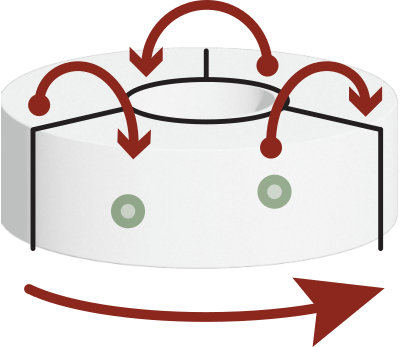
Close the circuit

Nonequilibrium Norton
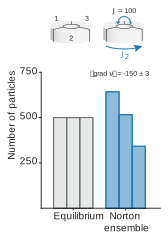
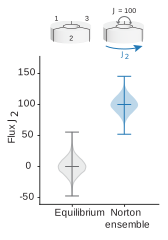
Connecting "paricle-motive" force to the lattice ends to fix the flux JJ: J=ij(n13ijn31ij) J = \sum_{ij} \bigl( {n_{13}}^{ij} - {n_{31}}^{ij}\bigr)
Principle of maximum microcaliber
Euler-Lagrange equations for stochastic thermodynamics: ni(t+dt)=mjpmij(dt) nmj(t) {n_\ell}^i(t + dt) = \sum_{m j} {p_{\ell m}}^{ij}(dt)\ {n_m}^j(t)
Diffusive random walks
Summing out energy levels ii, jj: n(t+dt)=mpm(dt) nm(t)n_\ell(t + dt) = \sum_{m} p_{\ell m}(dt)\ n_m(t)

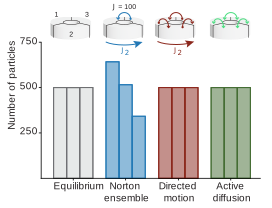
Equilibrium vs. Norton ensemble

Numerical simulations
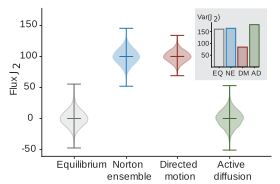
Steady-state diffusion with a gradient
Numerical simulations
Flux driven through the system by the gradient

Active ensembles

Numerical simulations Numerical simulations
Directed motion
JJ particles must move to the right
Active diffusion
JJ particles must move either to the right or left
Examples:
Myosin motors, self-propelling particles

Ensemble equivalence


Sorting of epiblast and premitive endoderm cells
Poissonian cellular Potts model for sorting of inner cellular mass in mouse embryo
Thévenin ensemble
Fix the Lagrange multiplier η\eta instead of the current JJ
Nonconservative force terms of the Langevin model (ηijηji)- (\eta_{ij} - \eta_{ji})
Generalized fluctuation theorem with noise level (ηij+ηji)-(\eta_{ij} + \eta_{ji})

🎱 And more...

  • Generelized detailed balance (e.g. Fermi-Dirac statistics)
  • Fluctuation relations
  • Statistical origin of transport coefficients
  • Inhomogeneous transport problems

⛳ Thank you for you attention!

Questions?

Phys. Rev. E 113, 014133 (2026)