
R. Belousov (@ribelousov), J. Elliott (@Jenna_Elliott_), F. Berger (@DrFlorianBerger), L. Rondoni, and A. Erzberger (@ErzbergerGroup) | Open Access by CC BY 4.0, Phys. Rev. E 113 (2026).
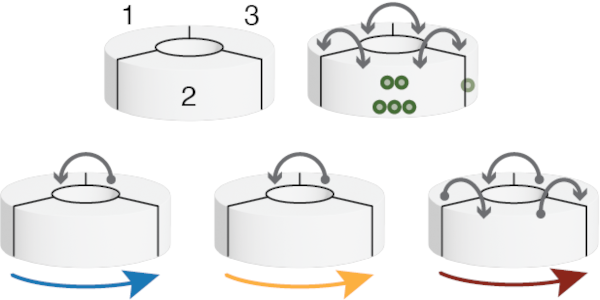
Classical thermodynamics was developed to describe systems at equilibrium—states that appear static, without currents of matter or energy. The microcanonical approach, introduced by Boltzmann and cast by Gibbs in a general framework of ensembles, is a cornerstone of statistical mechanics meant to justify the macroscopic equilibrium laws from the atomistic point of view. However, nonequilibrium thermodynamics has largely remained a phenomenological discipline, lacking a complete statistical foundation even for steady states that differ from equilibrium only by the presence of constant fluxes. Drawing insights from the information-theoretic ideas introduced by Jaynes, this work extends the microcanonical method by counting all possible microscopic realizations of a system’s trajectory. The probability of a trajectory is then determined by the number of its realizations, consistent with the physical constraints and all assumed equally likely. This framework advances the ensemble methods of statistical mechanics beyond the domain of classical thermodynamics, including driven, active and spatially-extended nonequilibrium systems.