
There are examples of abandoned physical models, such as the aether theory of electromagnetism. Sometimes they were even predictive: the geocentric model of solar system was detailed up to a nuance, mathematically precise, and highly accurate in forecasting the positions of planets.
Mathematics alone is though not enough. It takes an experiment to validate a theory—to harvest the facts that cement our knowledge.
The idea of a validating experiment comes from physics—our current understanding of the material world. We often say that a theory is found either consistent or inconsistent “with observations,” but what we actually test is whether it “fits” into the picture of the world that we have built so far.
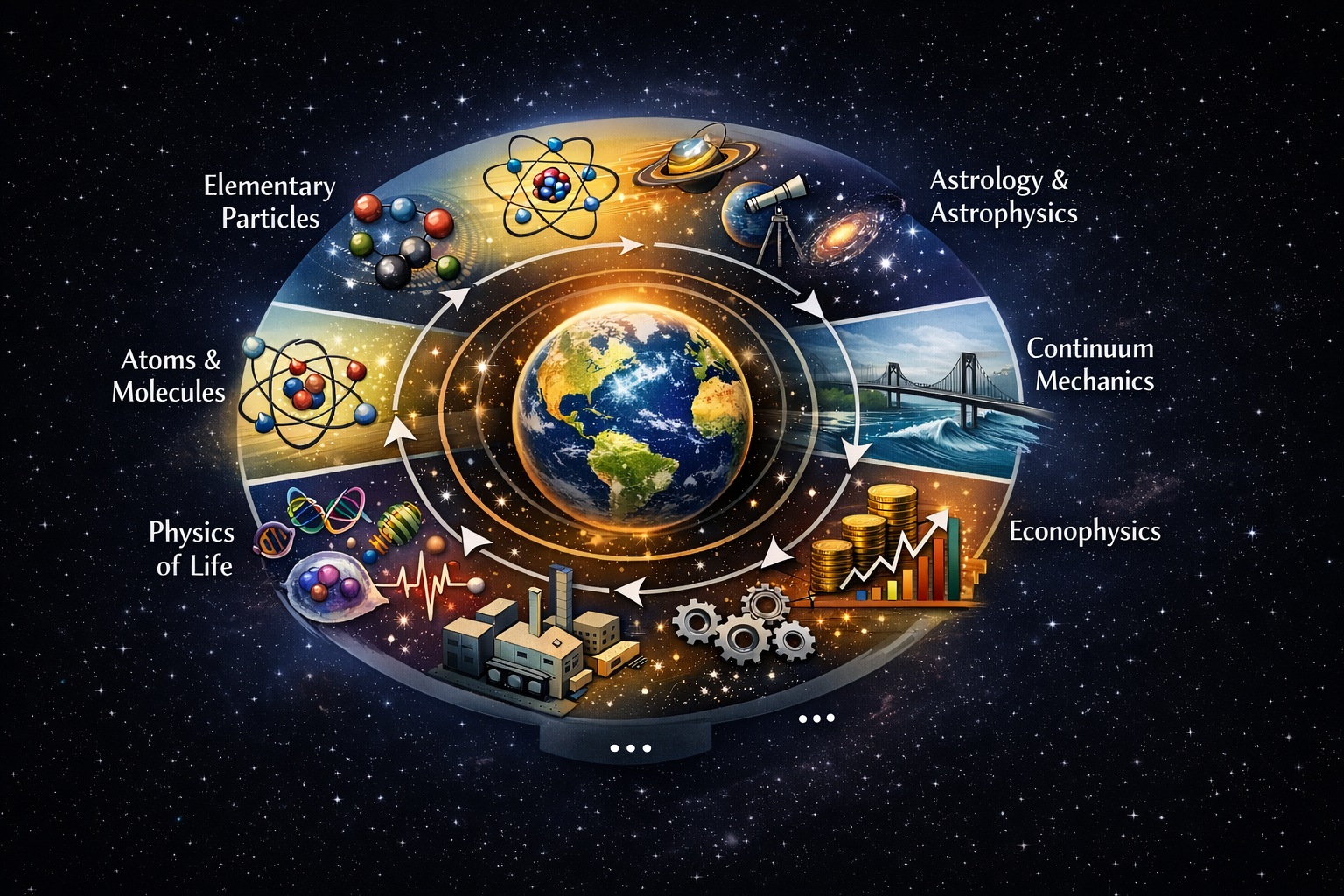
Such an integrative expansion of knowledge can bring transformative changes. Kepler’s model of planetary motion was later explained by Newton’s theory of gravity. Different domains of a successful theory are connected and support each other—they are not just a loose bunch of unrelated mathematical equations. Their boundaries can be crossed in a principled way: classical mechanics is now understood as an extremely effective approximation to more complex models from subatomic and high-energy physics. Today Physics has expanded far enough to tackle living matter, economics, and even industrial factories.
Then, is it not the scope of physics to describe the coherent, integral picture of the material world—the theory of matter (living or not 🙂)?
Illustrations are generated with ChatGPT and Gemini; prompt and selection by RB.