
Science is a very complex social phenomenon—a part of human culture, like art, politics, and so on. Therefore it has many different aspects that should be analyzed—and studied 😁.
What I find most irritating—sorry 😅—about AI maximalism is that its conclusions are often drawn from an oversimplified image of Science, typically from just one of its facets. These conclusions are then bluntly generalized to the whole phenomenon of science without so much as a hint of doubt.
For instance, some AI maximalists picture science as the following process:
- Make experimental observations.
- Generate a theoretical hypothesis that explains the observations.
- Propose tests of the hypothesis.
- Test the hypothesis experimentally.
- If the test fails, return to point 2; otherwise, put a “✓.”
Here I am not even discussing the fact that the above plan, like almost any other plan, rarely survives contact with the realities of life. This image often emerges from scientific publications, which never report the entire trajectory of a research project, with all its turns, dead ends, and reformulations. They present only the final shortcut that the research eventually identified.
Nevertheless, AI maximalism suggests that humans are no longer needed to generate hypotheses or propose tests. But how does AI generate hypotheses and tests—for example, in physics?
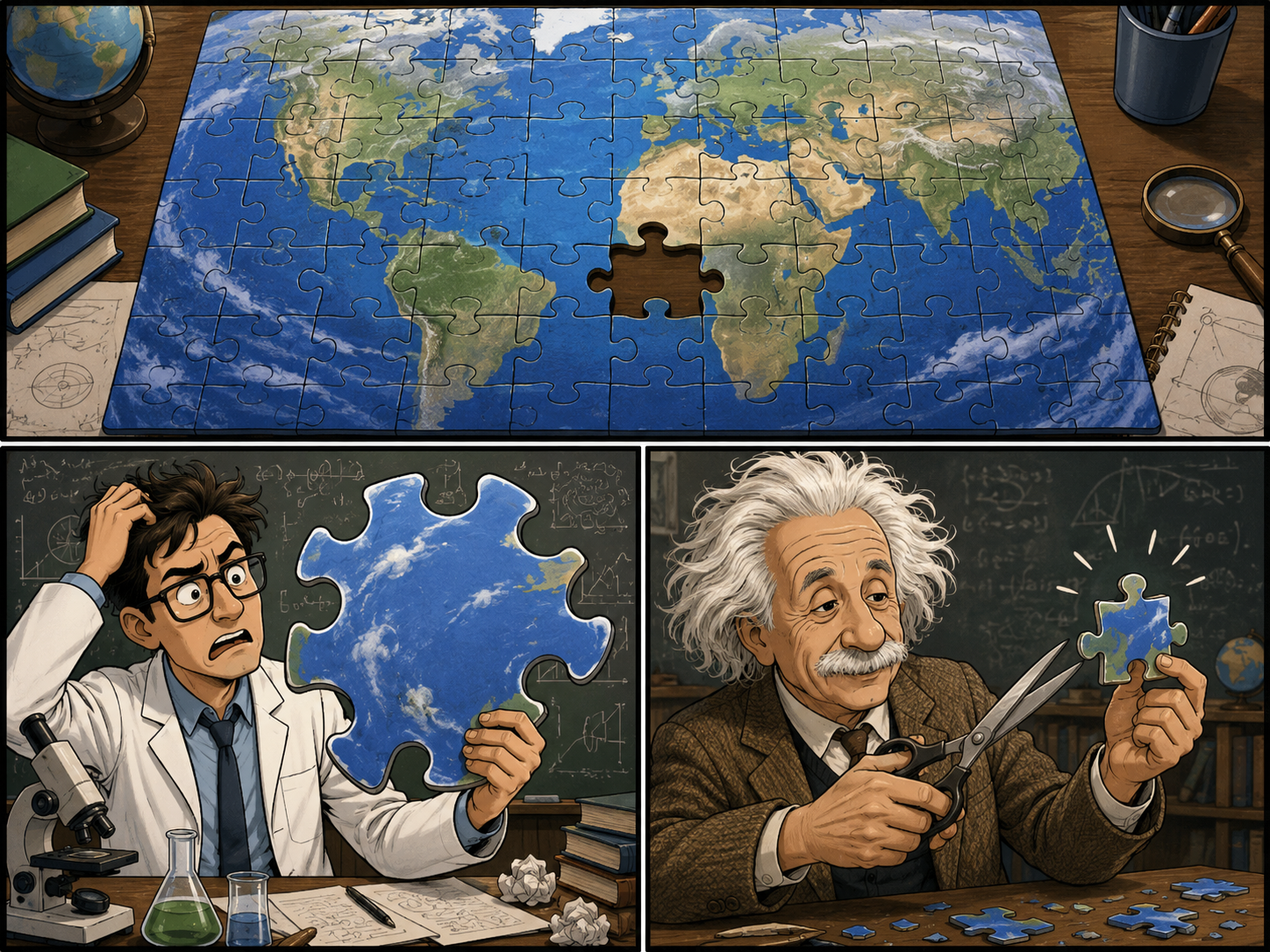
In my assessment, AI composes models and tests like a puzzle, using pieces of information retrieved from existing physical theory. I find it quite natural that transformers excel at such tasks. After all, we know that they compose texts and sentences remarkably well from elements of language—is that not similar to putting a puzzle together, like on the cover image?
But is that all what Science is about? I am sure—not. The pieces of information come from somewhere—they are not written in the Bible. Their meaning is continuously refined and questioned, while existing physical theory is ceaselessly transformed. All this turmoil drives the Scientific progress—one of the many everlasting processes in Science that may not be obvious to everyone outside the scientific life. The processes taking place in the human minds all the time, even after the AI stops printing its response to your query…
AI maximalism therefore reminds me of the anecdote about Lord Kelvin, which might be misattributed, but the idea of burying physics resurfaces quite frequently. I have even heard it expressed by colleagues in biology. Toward the end of the XIXth century, it could seem that there was “nothing new to be discovered in physics” and that “the future truths of physical science are to be looked for in the sixth place of decimals.” And then quantum physics and relativity entered into the picture…
Try talking to AI about any major outstanding challenge in physics—for example, quantum gravity or the emergence of the arrow of time in statistical mechanics. You will find that it basically translates and summarizes what is already known about the problem. These are information-retrieval and puzzle-composition tasks, and AI performs them remarkably well.
You may ask AI to solve for you that problem. You may then ask why the proposed solution is not commonly accepted. Eventually, you will find yourself circling around the fact that AI knows no more than current scientific knowledge can already tackle.
But how does scientific knowledge expand beyond that point? One of the most brilliant manifestations of human intelligence is dialectical synthesis—or sublation,—which occurs when reconciling existing facts requires us to generate a new thesis that did not exist before. Planck’s hypothesis of quanta, Schrödinger’s equation of motion, and special relativity emerged from the human mind in this way. They required what psychologists might call “thinking outside the frame”—as in the meme I generated with the help of ChatGPT 🤖.
Do you believe that AI could have assembled quantum mechanics from nineteenth-century physics? Do you think it would have initiated the relativity programme merely because the constancy of the speed of light conflicted with Galilean invariance? I surely do not…
In fact, one BIG question for higher education remains: how do humans become capable of dialectic synthesis, and how can we help them improve this ability? Most of the time, we simply solve problems by following (more or less) the research plan outlined above, moving from step 1 to step 5. Then, one day, we encounter a problem that does not yield. At that point, someone proves capable of performing a sublation of the existing facts and breathing something new into Science.
How can we train AI in dialectical synthesis if we do not even know how humans master it? Do we even need AI “to think outside the frame” at all? Of that I am not sure 😅…
Nonetheless, I am confident that we are still far from the time when we can bury physics—or human science—even in the era of AI 😉. In my experience, AI is excellent at removing routine work from research and leaving you with the creative part that it cannot handle—perhaps not yet, or perhaps not at all. No doubt, the tandem of human & AI will evolve. However not towards replacing the former by the latter. Instead, it will become something qualitatively different from merely the sum of the two 😉.
Cover image is generated with ChatGPT; prompt and selection by RB.