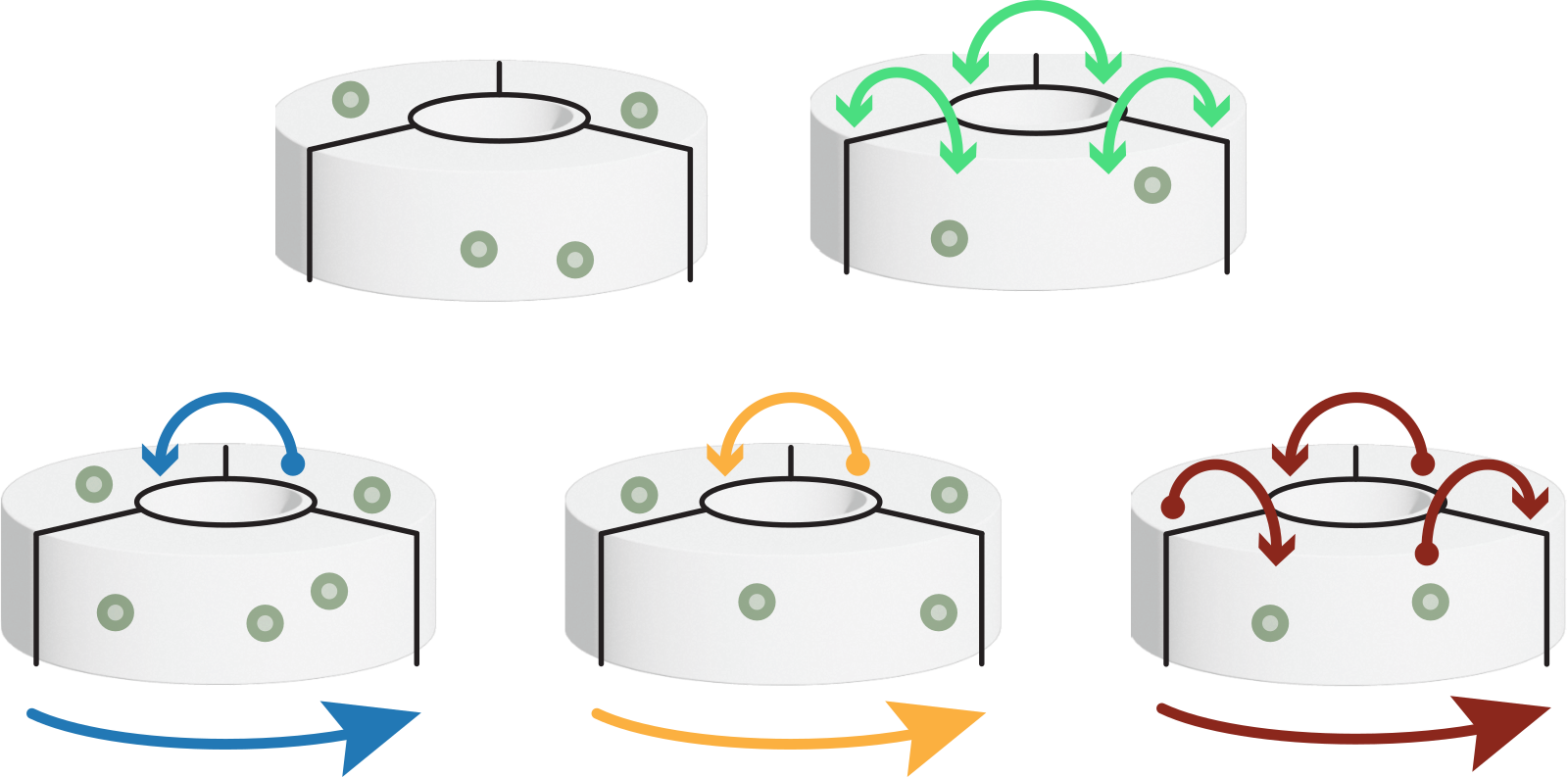
Page 1 / 1 Ensemble Theory of Active Fluctuations Sep 8, 2026 Living matter subsists on active, nonequilibrium processes. At small scales, physical theories of these processes compensate for a lack of statistical-mechanics foundations, available for equilibrium systems, with phenomenological laws. Using advances in first-principle microcanonical methods, we develop an ensemble theory of active fluctuations and illustrate its application to cell sorting. Presentation Microcanonical ensemble out of equilibrium Mar 12, 2026 The microcanonical ensemble serves as the fundamental representation of equilibrium thermodynamics in statistical mechanics by counting all possible realizations of a system’s states. Ensemble theory connects this idea with probability and information theory, leading to the notion of Shannon-Gibbs entropy and, ultimately,to the principle of maximum caliber describing trajectories of systems—in and out of equilibrium. While the latter phenomenological generalization reproduces many results of nonequilibrium thermodynamics, its physical justification remains an open area of research. What is the microscopic origin and physical interpretation of this variational approach? What guides the choice of relevant observables? We address these questions by extending Boltzmann’s method to a microcanonical caliber principle. This approach introduces a dynamical ensemble theory for nonequilibrium steady states in spatially extended and active systems, which we verify in numerical simulations. Presentation Newer 1 Older